MightyGanesha.com
 TheDivaReview.com











 The Go Master centers around the life of Wu
Qingyuan, a Chinese man, who, as a young boy exhibits a very remarkable
talent for playing the game, Go. Wu Qingyuan is persuaded at age 14 to
move to Japan, where Go tournaments are more frequent and lucrative, and
so he may further study Go while making a living playing competitively.
His talent and reputation make him a celebrity all throughout Japan, and
he is soon considered the greatest Go player in the world. “The
reincarnation of the Saint of Go”
The Go Master centers around the life of Wu
Qingyuan, a Chinese man, who, as a young boy exhibits a very remarkable
talent for playing the game, Go. Wu Qingyuan is persuaded at age 14 to
move to Japan, where Go tournaments are more frequent and lucrative, and
so he may further study Go while making a living playing competitively.
His talent and reputation make him a celebrity all throughout Japan, and
he is soon considered the greatest Go player in the world. “The
reincarnation of the Saint of Go”
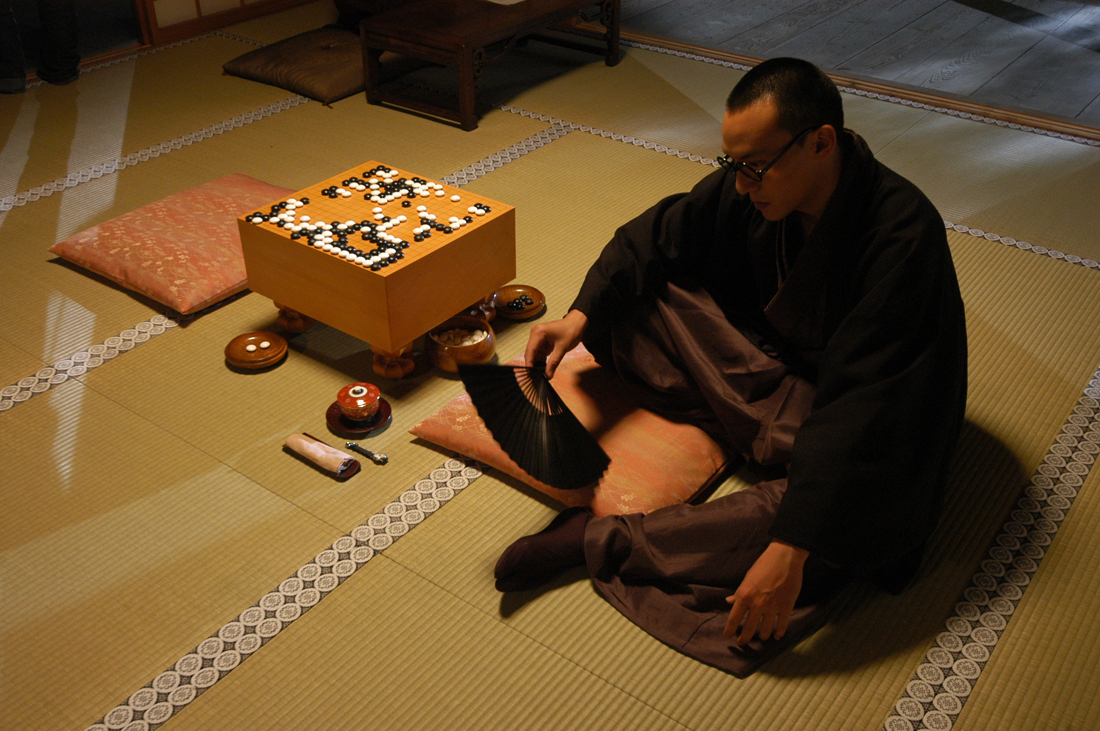
For those like me, who hadn’t heard of the game (- which dates back to ancient China) before seeing the film, Go is a strategy game that seems to be similar to chess. The competitions between two opponents are very intense, and matches can be played for the duration of a few minutes, or, according to the director, Tian Zhuangzhuang, can last for a year. Tian shows us players who fall ill and experience other horrific tragedies during games, but refuse to leave the Go table.
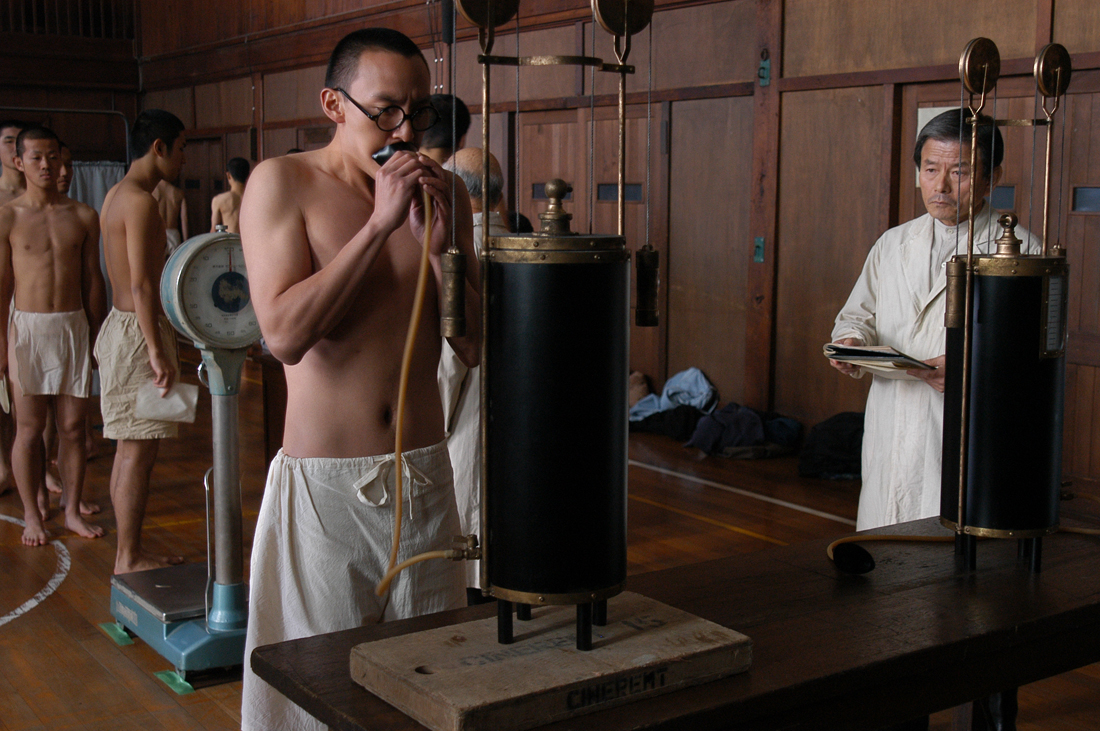
The majority of the film takes place during Wu’s early life in the late 1930’s, as military aggressions between Japan and China reach a boiling point. Some of the most dramatic scenes in the film occur during the WW2 bombings in Tokyo. Tian gives us a very direct view of the hardship and poverty faced by Japanese citizens throughout this time, through the eyes of Wu, who bears witness to it all as both a victim and an outsider.
The standout in this beautifully crafted piece is the performance of the Taiwanese actor, Chang Chen (- Crouching Tiger, Hidden Dragon; Chinese Odyssey 2002; Three Times). His controlled, sensitive performance keeps you completely riveted in this sternly paced, patiently told tale. There is precious little dialog in the piece; Chang’s face registers everything that Wu sees, open and clearly as an innocent; his wide eyes conveying every mood Wu feels. Wu’s search for inner peace and truth is the motivation of the film, and as a viewer, Chang makes you sympathise with the anguish of his search. You feel Wu’s displacement and inner turmoil after being asked by his teachers to become a Japanese citizen and his isolation when he will not celebrate a war victory over China with his Japanese peers. You are warmed by his awkwardness at his tentative steps at first love with the young Japanese girl who will become his wife. Chang expresses Wu’s heartbreak and betrayal after joining a religious sect in an attempt to find spiritual solace away from the all-encompassing world of Go. Chang’s face became a canvas upon which all of Wu’s experiences were painted. I predict that Chang will receive many award nominations for his powerful, moving, masterful performance.
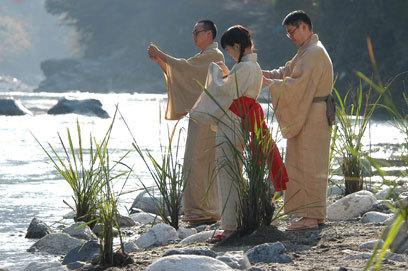
The other outstanding point of the film is the beautiful artistic production and cinematography. The spectrum of vivid colours in the palette of the film that run from full, bountiful greens and blues, to stark, gray dreariness, gives it a dreamlike quality. The Go Master was filmed predominantly in Japan and Director Tian makes full use of the beautiful scenery of Kobe, and its lush forests and hills. The scenes of Wu in the Go Academy are filmed in rural woodlands that reflect the calmness and peace Wu yearns for and thrives upon. The scenes of gray, harrowing destruction post-WW2 directly coincide with the desolation and unhappiness that haunts Wu’s life at that point.
Director Tian gives us many scenes during the film that, like life, are not wrapped up neatly, but open ended and perhaps not resolved. The sensitivity of Tian’s focus on Wu’s search for spirituality resounds deeply throughout the film; the director truly understood Wu’s quest for inner peace and the narration rings true. Tian Zhuangzhuang chronicles the life of this fascinating man, Wu Qingyuan, and with remarkable restraint, makes no judgments on his life, or, what might be considered the controversial way he chose to live it. This film is a beautifully crafted marvel.
- Mighty Ganesha
Photos
(Courtesy of Fortissimo Films)
|
|
|
|
.jpg)