











Do Your Bit for Fabulosity.
Don’t hesitate, just donate.
Hey boys and girls, we’re thrilled to have two more amazing exclusives by our roving reporter, Ms. Melissa Castor, who puts us at the scene of the visual kei group, Matenrou Opera’s American concert debut at Virginia’s Anime USA. Then keep on reading for Melissa’s excellent interview with the band.
Dig it!
Matenrou Opera Live at Anime USA,
November 19th, 2011

Matenrou Opera emerged on stage shortly after convention goers were
admitted into the hotel ballroom where the concert was to be held. They
looked elegant and refined in their attire, but their music was not your
typical “opera.” The fast drumbeat mixed with the rapid pace of the
guitar and bass had the audience going wild as soon as this visual kei
band began playing.
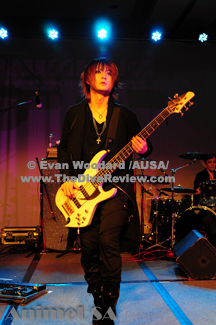 They
started off with INDEPENDENT, a high-energy song off their last album,
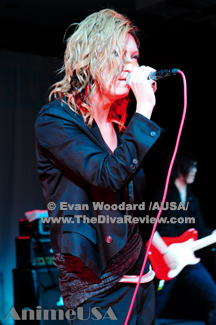
Abyss. Vocalist Sono went straight into an MC following this song, most
of which was in Japanese. Despite being in America, very little of his
MCs were in English. He finished off his short Japanese MC by saying, “I
am going to show you good time! Are you ready?”
They
started off with INDEPENDENT, a high-energy song off their last album,
Abyss. Vocalist Sono went straight into an MC following this song, most
of which was in Japanese. Despite being in America, very little of his
MCs were in English. He finished off his short Japanese MC by saying, “I
am going to show you good time! Are you ready?”
They next played their
newest single, out October 19th of this year, Otoshiana no
Soko wa Konna Sekai. It was a treat to hear a song that has only been
out for a month, a fairly new song some Japanese fans may not have heard
yet.
The lighting was done perfectly to match the songs, especially Diorama
Wonderland. The lights constantly changed color during this song and
were just crazy, as the song is. The beginning of Diorama Wonderland has
a lot of interesting lyrics: “Crazy beasts - killing each other
// Crazy
plants - feeding a dream //
Crazy humans - playing with other species
//
Crazy words - proving our egos” among others, with multiple phrases
being in English.
Sleeping Beauty is the third song off of the Otoshiana… single. It was not originally on the set list, but handwritten in and added last minute to make a fifteen-song long, hour and a half set.
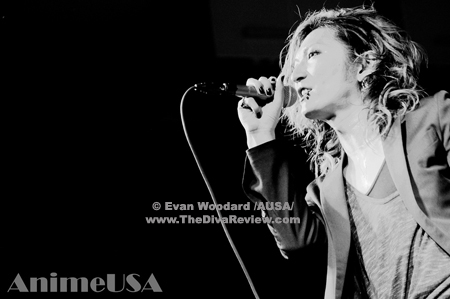 Helios
is a beautiful song with very sad lyrics. It was written shortly after
the earthquake in Japan on March 11th and emanates feelings
based on that event. One could feel the emotions Sono portrayed very
strongly during this song. He remained stationary in the center of the
stage, holding onto the microphone stand, pouring his heart into this
song. It gave off a warm feeling, but also one of despair. Drummer Yu
could be seen singing along to quite a few songs, but especially Helios.
Helios
is a beautiful song with very sad lyrics. It was written shortly after
the earthquake in Japan on March 11th and emanates feelings
based on that event. One could feel the emotions Sono portrayed very
strongly during this song. He remained stationary in the center of the
stage, holding onto the microphone stand, pouring his heart into this
song. It gave off a warm feeling, but also one of despair. Drummer Yu
could be seen singing along to quite a few songs, but especially Helios.
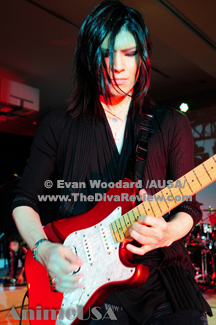 After
Helios, only the fifth song of the night, Sono walked offstage without a
word as the remaining four members began to play an instrumental track,
Utopia. This song was perfect to show off all of the members’ skills
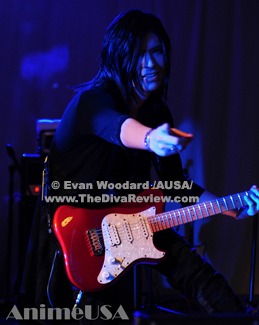
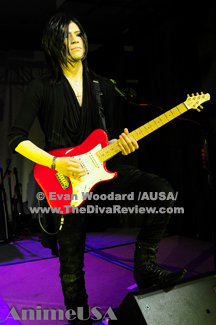
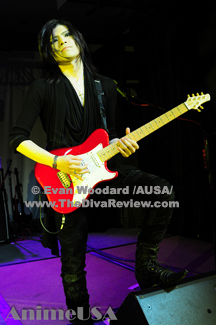
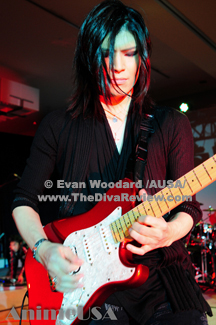
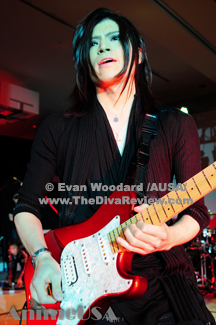
with their instruments. Guitarist Anzi particularly stood out with his
expert guitar work, not only on Utopia, but also on a number of songs
during the set. He is undoubtedly a talented guitarist. Matenrou Opera
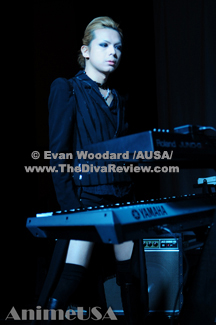
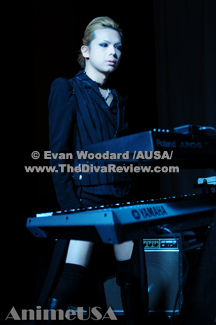
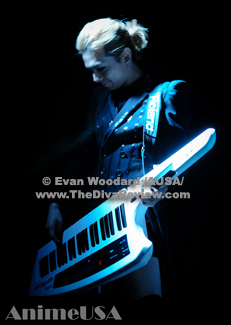
has a unique, essential part of their band – a keyboardist. Keyboardist
Ayame was also able to showcase his talent during this song, with the
piano-based intro and outro before the other instruments joined in.
After
Helios, only the fifth song of the night, Sono walked offstage without a
word as the remaining four members began to play an instrumental track,
Utopia. This song was perfect to show off all of the members’ skills
with their instruments. Guitarist Anzi particularly stood out with his
expert guitar work, not only on Utopia, but also on a number of songs
during the set. He is undoubtedly a talented guitarist. Matenrou Opera
has a unique, essential part of their band – a keyboardist. Keyboardist
Ayame was also able to showcase his talent during this song, with the
piano-based intro and outro before the other instruments joined in.
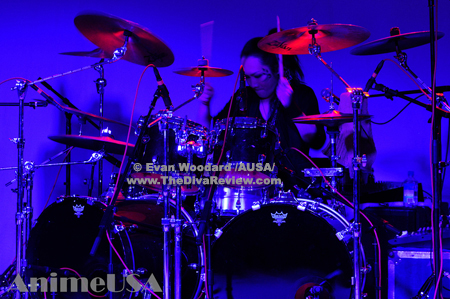
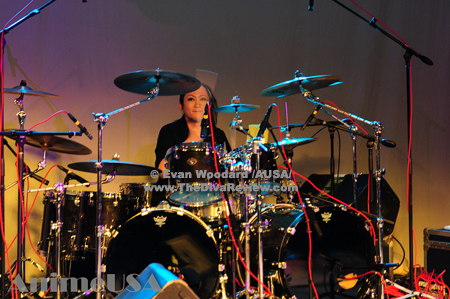 Following
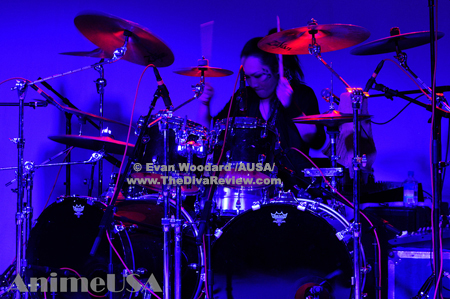
this song, three more members left the stage, leaving only Yu behind his
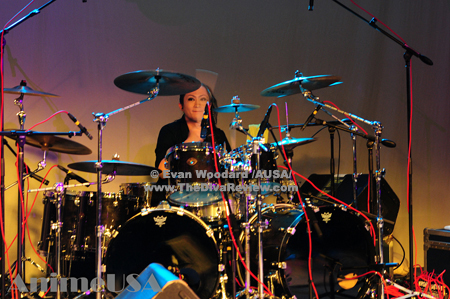
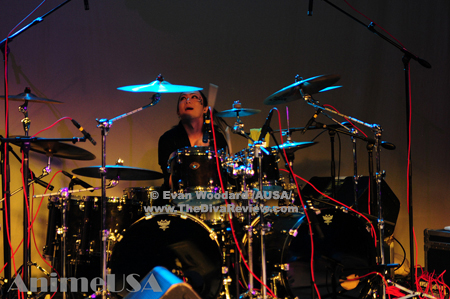
drum kit. Yu’s drum solo was powerful, full of energy and he could be
seen enjoying himself, grinning as he played. After a few minutes of
playing and showing off what he could do, he started a beat to which the
audience clapped along. The other members began to emerge back on stage
at this point, also clapping along. As they began playing the intro to
frill, Ayame continued clapping along flamboyantly, for as long as he
could, moving to the edge of the stage to engage the audience.
Following
this song, three more members left the stage, leaving only Yu behind his
drum kit. Yu’s drum solo was powerful, full of energy and he could be
seen enjoying himself, grinning as he played. After a few minutes of
playing and showing off what he could do, he started a beat to which the
audience clapped along. The other members began to emerge back on stage
at this point, also clapping along. As they began playing the intro to
frill, Ayame continued clapping along flamboyantly, for as long as he
could, moving to the edge of the stage to engage the audience.
Another MC followed, including member introductions by Sono.
“He is crazy – on drums, Yu!”
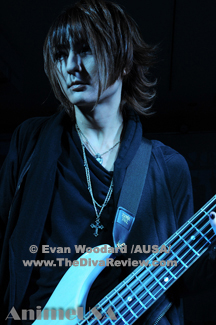
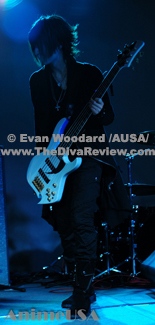
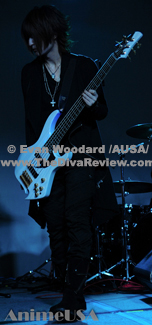
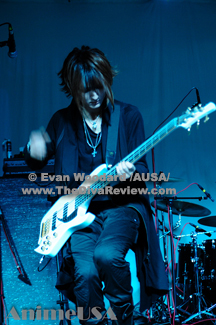
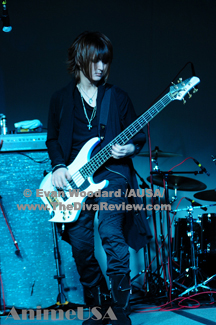
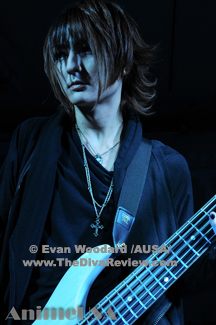
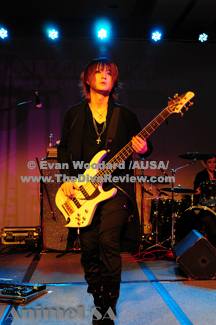
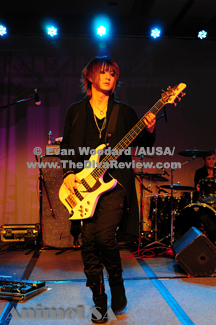
“He is muscle – on bass, Yo!” – to which Yo started playing Super Mario
Bros. theme song on his bass.
“He is very, very cute – keyboard, Ayame!”
“He loves sexy girls. On guitar, Anzi!”
“I have a request… please shout my name! On vocal-“ and the audience
shouted Sono’s name back to him several times.
During the intro to Hiai to Melancholy, Sono would sing a phrase and the
audience would sing it back to him. All the members switched positions
on stage, moving around a great deal, giving the audience a chance to
see each of them up close.
 Repeating
back what Sono had just sung continued on during Adult Children. At the
chorus, he said, “Can you fuckin’ feel me?” and the audience replied
back the same phrase. Sono did not outright tell people to headbang, but
they needed no instructions -- the music itself was enough to get people
to headbanging during the entire set.
Repeating
back what Sono had just sung continued on during Adult Children. At the
chorus, he said, “Can you fuckin’ feel me?” and the audience replied
back the same phrase. Sono did not outright tell people to headbang, but
they needed no instructions -- the music itself was enough to get people
to headbanging during the entire set.
“Calling you… Next song, is the last song. COCOON.” COCOON had a
majestic and grand feel about it; a stunning way to end the live. Sono
trusted in the audience to sing back to him Japanese lyrics. “Calling
you I'm Calling you, Ima kimi wo boku wa kimi wo yondeiru
//Calling
you I'm Calling you,
Utatte kure hitorikiri no uta wo issho ni”
This phrase was repeated four or five times, with only faint
instrumentals playing, having the focus on Sono and the audiences
voices.
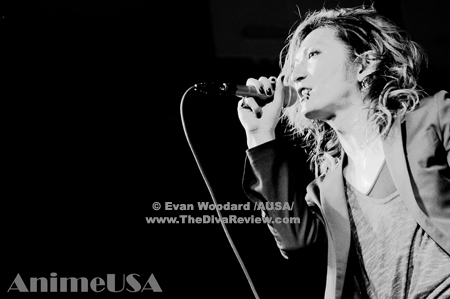
Throughout the show, Sono’s voice never lost power and he hit vibrato in
all the right places.
“I love you all!”
The energy didn’t die down at all for the encore, the members returning in tour shirts they had for sale. “Do you still have energy?” Sono asked.
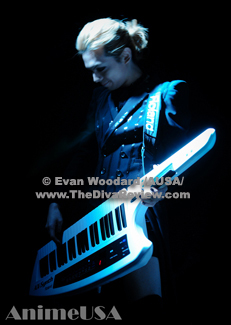 Honey
drop had everyone in the room jumping with renewed energy and the floor
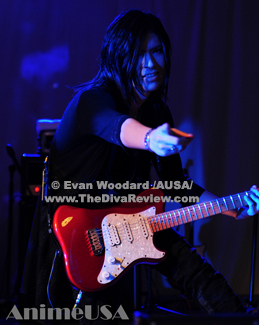
shaking. During one part, Sono went over to Anzi’s side and Anzi played
guitar facing Sono. Meanwhile, Ayame played his keytar close to Yo on
bass.
Honey
drop had everyone in the room jumping with renewed energy and the floor
shaking. During one part, Sono went over to Anzi’s side and Anzi played
guitar facing Sono. Meanwhile, Ayame played his keytar close to Yo on
bass.
Honey drop went right into the final encore song of the evening,
Boukyaku celluloid, which had everyone headbanging. All members came
together during the middle of the song, playing side by side. They all
went to separate edges of the stage and stepped down onto platforms to
bring them closer to the audience. At one point, Sono jumped off the
stage completely right in front of the audience, giving high fives and
clapping anybody’s hand he could reach. Yo, meanwhile had taken one of
Yu’s drumsticks and was playing his bass with a drumstick. When he
finished, he threw that drumstick into the audience.
The band left the stage smiling, happy with their performance – as was
the audience. Anzi threw guitar picks and Yu threw some of his
drumsticks. This was Matenrou Opera’s first time playing in America, but
hopefully not their last. They have a lot to offer and put on an
enjoyable show, one worth checking out.
Setlist:
1
INDEPENDENT
-MC-
2 Otoshiana no Soko wa Konna Sekai
3 Diorama Wonderland
4 Sleeping Beauty
5 Helios
6 Utopia
7 Drum Solo
8 frill
-MC-
9 Hiai to Melancholy
10 Murder Scope
11 Adult Children
12 ANOMIE
-MC-
13 COCOON
___________________________
EN1 honey drop
EN2 BOUKYAKU CELLULOID
~ Melissa Castor
November 19th, 2011
Matenrou Opera
Exclusive Interview at Anime USA

Melissa Castor: May I first ask you to introduce yourselves and your position in the band?
Sono: Vocal no Sono desu.
Anzi: Guitar no Anzi desu.
Ayame: Keyboard no Ayame desu.
Yo: Bass no Yo desu.
Yu: Drum no Yu desu.
 MC:
How did you decide upon the name “Matenrou Opera” [摩天楼オペラ]?
MC:
How did you decide upon the name “Matenrou Opera” [摩天楼オペラ]?
Sono: The concept of the band is a combination of the new and the old, actually; when I was watching the anime, BLOOD+, that’s a random phrase they had in the show, “Matenrou Opera.” When I heard this phrase, I felt that this was perfect for the concept I was thinking about for the band.
MC: What did you think about your first performance in America? How does an American audience compare to a Japanese audience or a European audience?
 Yu:
We had an image that the fans were going to be a lot more intense, and
we were right. One thing that stood out and was very fresh to us was
even at quiet parts of the songs, people would actually scream for us
and raise their voice. That’s not something that happens in Japan. In
Japan, they have this tendency that if the band becomes quiet, the
audience also becomes quiet. Another thing that doesn’t really happen in
Japan is when the members are in a line, and they start cheering for us
a lot more, that too was really fresh.
Yu:
We had an image that the fans were going to be a lot more intense, and
we were right. One thing that stood out and was very fresh to us was
even at quiet parts of the songs, people would actually scream for us
and raise their voice. That’s not something that happens in Japan. In
Japan, they have this tendency that if the band becomes quiet, the
audience also becomes quiet. Another thing that doesn’t really happen in
Japan is when the members are in a line, and they start cheering for us
a lot more, that too was really fresh.
Comparing the American fans to the Japanese fans and European fans, we
felt that the European fans are very similar to the American fans.
MC: Where does the inspiration for your visual image come from?
Sono: The inspiration comes from our songs.
MC: What message do you hope to have given to those who did not know the name “Matenrou Opera” before this weekend?
Ayame: It’s our first time in America, so there were definitely a lot of people hearing us for the first time. I wanted to be able to show them what Matenrou Opera’s coolness is; I wanted to convey that feeling perfectly.
 MC:
How did you get started in music?
MC:
How did you get started in music?
Anzi: When I was about 3 or 4 years old, my parents had me learn violin. My father was really into classical music, and he thought it would be nice if his child could play classical music. After about 8 years of playing violin, I quit, but it’s because of that experience that I am the musician I am today.
Ayame: When I was a child, I really liked Jpop music. I would always watch it on TV. I always thought, ‘I really want to be a part of that world.’
Sono: In elementary school, I actually saw X Japan. I was very shocked by both the visual and the sound. From that day, I felt I would like to be on that side to be able to influence people.
Yu: I was also influenced by X Japan and Yoshiki, and began drumming.
Yo: I originally liked music very much and I have about 3,000 CDs. From there, I wanted to try playing bass and so I did. It was a lot of fun, and it just continued on from there.
MC: What bands have influenced you to be the people you are today?
Anzi: Yngwie Malmsteen, he’s a guitarist. And the reason I first started playing guitar was Iron Maiden.
Ayame: The band that influenced me to want to be in a band was L’Arc~en~Ciel.
Sono: X Japan’s Yoshiki and B’z vocalist, Inaba Koshi.
Yu: Of course, X Japan is part of it, but also Germany’s Helloween and Metallica from America.
Yo: The person that I think is cool as artist and a band is Luna Sea.
 MC:
You covered X Japan’s song “Kurenai” on the compilation “Crush!”, a 90s
cover album. What did you think about covering this song, which was
performed by such a well-known band in the visual kei scene?
MC:
You covered X Japan’s song “Kurenai” on the compilation “Crush!”, a 90s
cover album. What did you think about covering this song, which was
performed by such a well-known band in the visual kei scene?
Sono: We covered it because we are a metal band within the visual
kei scene, and X Japan is also a metal band. It is also because they
influence us. We thought, ‘Who else should cover this song other than
Matenrou Opera?’
MC: This year, Matenrou Opera has released two singles. The lyrics of
Helios are very different from those of Otoshiana no Soko wa Konna Sekai
(落とし穴の底はこんな世界).
The songs have opposite feelings.
How did your thoughts or song writing process differ between the two
songs?
Sono: Helios was written about the earthquake and tsunami that happened. The lyrics focus on the topic of life and light - to keep on going. It is about the power of life and to live on. Otoshiana wasn’t influence by anything; it was straight from the song. The lyrics were influenced by the music. The lyrics are like a weapon going into the darker side, which is why it is completely opposite.
MC: From the Otoshiana… single, Diorama Wonderland has some “crazy” and creative English lyrics. Why did you choose to have a good portion of the song in English?
Yu: When we composed the song, if you listen to the melody, we felt English sounded better with it rather than Japanese.
MC: Do you think it was important to include English lyrics to communicate with Western fans?
Sono: English is very important, because the reactions of the fans
when I started singing in English last night at the live were like, “Oh,
he’s singing in English.” It is that kind of feeling. Of course, the
Japanese lyrics are very important too, but we would also like to
incorporate more English.
MC: Is learning English something any of you want to do?
*every
member raises their hand*
MC: What has been your favorite part about being in America?
All: We are all very bright and happy. {–chatter amongst themselves for a few moments-} We are all very accepting. We don’t really care about details, we are just happy to be here.
MC: Did you do anything fun or something you particularly enjoyed?
Ayame: We took a trip into Washington, D.C. We saw the White House
and the Lincoln Memorial.
 MC:
If you could do one thing while you were in America (and you could
not do it this time), what would you like to do? What would you do
if you had all the time in the world?
MC:
If you could do one thing while you were in America (and you could
not do it this time), what would you like to do? What would you do
if you had all the time in the world?
Yu: I really like sports. When you think about American sports, you think of football, so I would like to go see a football game. My favorite baseball player is Ichiro [Suzuki], I would like to see a Seattle Mariners game.
Sono: I would like to record in America. It’s a different atmosphere. I believe American bands are very vast and grand, so I want to know what Matenrou’s music would sound like in an American setting.
Anzi: I would like to pick up some blonde beauties and hang out with them, be in a limousine; have two on each side.
MC: Like a pimp?
Anzi: (in English): No, no, I am gentleman.
Yo:
(in English): He is rock star.
More than doing one thing, I would like to live here for a while. I
would like to see the vast nature and things such as that. Right now is
just a small portion of America; it needs to be taken in within a long
period.
MC: *begins asking next question*
Ayame: Ehhh?
*everyone laughs, as Ayame was skipped over*
Yu: (in English) Good!
Anzi: (in English) Nice job.
MC:
Sorry!!
 Ayame:
When Obama became President, the funding for space exploration and that
sort of stuff was cut down. I think that it's a waste, because America
is such a huge power in the world, such a leader, it is part of their
responsibility, having all this money and all this power, they should be
doing more in terms of space exploration. Another reason is, a lot of
people were thinking, that NASA was actually going to lead going into
deeper space [such as Mars] and the exploration program.
Ayame:
When Obama became President, the funding for space exploration and that
sort of stuff was cut down. I think that it's a waste, because America
is such a huge power in the world, such a leader, it is part of their
responsibility, having all this money and all this power, they should be
doing more in terms of space exploration. Another reason is, a lot of
people were thinking, that NASA was actually going to lead going into
deeper space [such as Mars] and the exploration program.
Yo: It was okay up to the point of NASA, but I was hoping Ayame
would say he wants them [America] to build a Pokémon Center!
MC: In 2012, you will be together for 5 years as Matenrou Opera. What do you think has been one of your biggest accomplishments since Matenrou Opera was formed?
Sono: The biggest step in Japanese bands is to go major and we feel
that being able to go major was one the big footsteps we were able to
make.
MC: Where do you see the band headed musically in the future?
Sono: Since had our major debut, we have become more strongly for the meaning of the band of, “Matenrou Opera.” We would like to hold on strongly to our concept and keep on going. We also want people to just listen to the intro of our songs and know right away that it is Matenrou Opera.
Thank you very much ! !
~ Melissa Castor,
Special Correspondent for The Diva Review
November 20th, 2011

© 2006-2022 The Diva Review.com
|
Photos Courtesy of Evan Woodard for Anime USA & Bellwood Records
Do Your Bit for Fabulosity. Don’t hesitate, just donate.
|








|
|